AI English – Learn & Speak
- 0.0
- Rating
- 500.00K
- Installs
- Free
- Price
 Analysis by App-foxy
Learning English is easy to postpone because the usual options can feel demanding: a scheduled class requires commitment, a textbook can feel passive, and a conversation partner is not always available. AI English – Learn & Speak takes a more flexible route by presenting itself as an English-learning app with an AI tutor at its center. I found its appeal strongest when I wanted a quick practice session without arranging a lesson or opening a full course.
The app comes from EZPub and sits in the Education category. It is free to install, aimed at Everyone, and currently supports devices running Android 8.0 or later. Its store presence shows over 500K installs, while the displayed average rating is 0.0, so I would treat the install figure as evidence of reach rather than as proof that the experience suits every learner.
How AI English – Learn & Speak fits into everyday study
The central idea is straightforward: use an AI-based tutor to make English practice more available during ordinary gaps in the day. That matters because language progress usually depends less on one long study session than on returning to the language often. I can imagine opening it while waiting for an appointment, rehearsing a few sentences before a trip, or using it after work when I have enough energy for practice but not for a formal lesson.
You May Also Like

 Blood Strike: 2.5 Anniversary
Blood Strike’s Loadouts Turn Every Drop Into a Tactical Gamble
A close look at Blood Strike’s custom loadouts: how fast access to signature weapons reshapes its battle royale rhythm, rewards preparation, and narrows the gap between fights.

 Pandora - Music & Podcasts
Pandora’s Music Is Easy to Start, but Harder to Recover
Pandora’s strength is its low-effort path from a seed to a station. Its weak spot is how much confidence it asks you to place in connection, setup, and quiet recovery.

 8 Ball Pool
 Is Built on Rivalries, Rematches, and Routine
A close look at the rivalries, rematches, shared routines, and unanswered safety questions that turn a quick pool match into a persistent mobile community.

 Samsung Music
’s Quiet Strength Is Playing What You Already Own
Its reach comes less from spectacle than from dependable access to a personal library. That simplicity is both the app’s strongest retention engine and its ceiling.

 AccuWeather: Weather Radar
AccuWeather Review: A Quick, Clear Forecast for Everyday Decisions
For everyday plans, the best forecast is the one you can understand quickly. AccuWeather makes rain timing, radar, and local conditions easy to act on, with a few trade-offs.

 Hill Climb Racing
Why Hill Climb Racing Still Turns Crashes Into One More Run
A tiny car, a bumpy hill and one more upgrade: Hill Climb Racing keeps resurfacing because its simple chaos makes every near-miss feel personal.
More From Our News Desk



What makes this different from a conventional vocabulary app is the emphasis on speaking and interaction suggested by its name. A flashcard tool is useful for recognition, but it does not automatically address the hesitation many learners feel when forming a sentence aloud. An AI tutor can be more approachable than a live teacher for low-pressure attempts, especially for someone who wants to make mistakes privately before speaking with another person.
That convenience should not be confused with a complete replacement for an English course. An AI conversation can help with practice, but a learner who needs a carefully sequenced curriculum, examination preparation, or detailed instruction from a qualified teacher may still need another resource. I see this app more as a practice companion than as the only tool in a serious long-term study plan.
What the free access means in practical terms
The app is free, which removes the biggest barrier to trying it. I would install it first and judge the quality of the actual practice before spending anything. That is particularly sensible here because the listed average rating is 0.0, leaving no useful rating signal to guide a purchase decision. The app’s free entry point is therefore its clearest value advantage.
There are in-app purchases priced from $3.99 to $13.99 per item. Those prices establish that optional paid elements exist, but they do not tell me which learning functions are included in each purchase. I would not assume that paying unlocks a complete course, removes every restriction, or provides teacher-level feedback. The sensible approach is to use the free portion, identify the exact limit that affects your routine, and then decide whether the paid option solves that specific problem.
This distinction is important for learners with different goals. Someone who only wants occasional speaking prompts may find the free experience sufficient. Someone who intends to practice every day could see more value in a paid item if it makes regular use easier, but only after checking what that item actually adds inside the app. In other words, the free download is easy to recommend for testing; the paid value depends on the purchase screen and the features it describes at the moment of use.
Where the app can deliver useful learning value
The strongest potential benefit is reducing the friction between deciding to study and actually beginning. Traditional alternatives often require choosing a lesson, finding a quiet time, or following a fixed sequence. An AI tutor can make practice feel more immediate. For a learner who repeatedly says, “I will study later,” that lower starting cost may be more valuable than a large library that rarely gets opened.
I would use it in short, focused rounds rather than treating every session as an open-ended chat. Before starting, I would choose one practical aim: explaining my weekend, asking for help in a shop, introducing my job, or describing a problem while traveling. Keeping one purpose in mind makes the interaction more useful than jumping between unrelated subjects.
A particularly effective workflow is to attempt a sentence without preparing it perfectly, notice where communication becomes difficult, and then repeat the idea more clearly. This turns the app into a rehearsal space rather than a passive answer generator. The point is not to produce flawless English immediately; it is to expose the gaps that prevent a simple message from coming across.
Another useful habit is to keep a small personal list outside the app of expressions that repeatedly cause trouble. After a session, I would write down only a few items and reuse them in the next practice round. That prevents the common problem of having a pleasant conversation with an AI but remembering very little afterward. The app can provide the interaction, while the learner supplies the repetition that makes it stick.
Speaking practice is helpful, but it has boundaries
For shy learners, private AI practice can be less intimidating than joining a group class. I can make an awkward attempt, try again, and work on fluency without worrying about another person’s reaction. This is especially useful for preparing predictable situations such as checking into accommodation, answering a basic interview question, or making small talk with a colleague.
Still, simulated conversation is not identical to real communication. Human speakers interrupt, change topics, use slang, misunderstand, and bring different accents and expectations. An AI practice session may help me organize sentences, but I would not rely on it alone to prepare for every real-world listening challenge. A conversation group, tutor, or regular exchange with another person remains better for handling unpredictability.
The app also should not be treated as an unquestionable authority on every correction or explanation. When a suggested phrase sounds unnatural, I would compare it with a trusted dictionary, a coursebook, or an experienced teacher. This is not a reason to avoid the app; it is a reason to use an AI tutor with judgement. The most reliable role is guided practice, not final certification of advanced grammar or professional language.
Tradeoffs compared with common alternatives
Compared with flashcard apps, this tool is potentially stronger for producing language rather than merely recognizing it. Flashcards are excellent for building a basic word bank and reviewing it efficiently, but they do not always show whether I can use those words in a sentence. AI English – Learn & Speak makes more sense after I already know some vocabulary and need to turn it into usable communication.
Compared with a structured language course, the AI approach may feel more flexible but less predictable. A course normally tells me what to study next and gives a clear progression. Here, I would need to bring my own discipline and choose topics carefully. Beginners who feel lost without a syllabus may prefer a guided course first, then use this app for extra speaking practice.
Compared with a live tutor, the app is more convenient and less socially demanding, but it cannot provide the same human judgement. A teacher can notice a recurring pronunciation issue, adapt an explanation to my background, and understand why I am struggling. The app is better for frequent low-cost practice; a tutor is better when I need diagnosis, accountability, or preparation for a high-stakes goal.
Compared with free videos and podcasts, the app offers a more active reason to respond. Videos are useful for listening to natural speech, while podcasts can build endurance and expose me to varied voices. Neither automatically makes me speak. I would combine them rather than choose only one: listen to a short piece elsewhere, then use the app to retell the main idea in my own words.
A realistic routine for a busy learner
Imagine a learner who works in a hotel and understands written English reasonably well but freezes when guests ask unexpected questions. I would suggest using the app before a shift to rehearse three situations: explaining a delay, recommending a nearby place, and asking a guest to repeat information politely. The learner could first answer naturally, then try again with shorter sentences and clearer transitions.
The next day, I would change the conditions instead of repeating the same script word for word. Ask for a more polite version, a shorter version, or a response to an irritated customer. This kind of variation is more valuable than memorizing one perfect dialogue because it trains flexible language. After work, the learner could note which real interaction felt difficult and turn that exact problem into the next practice topic.
That routine also reveals a limitation: the app cannot create motivation on its own. If the learner opens it without a goal, chats briefly, and never revisits difficult expressions, the activity may feel productive without producing much improvement. The best results will come from connecting each session to a real communication need.
Who is most likely to benefit
I would recommend trying it to learners who already know basic English and want more opportunities to form sentences. It may also suit people who dislike speaking in front of classmates, travelers preparing for common situations, and workers who need to rehearse polite everyday communication. The free access makes experimentation low-risk, and the Everyone age rating keeps the app broadly approachable for general learners.
It is less suitable as a sole resource for a complete beginner who needs every concept introduced in order. It is also not my first choice for someone preparing for a formal exam, studying specialized legal or medical English, or seeking a pronunciation assessment that carries professional weight. Those users need a clearly documented syllabus, expert feedback, or exam-specific practice alongside any AI conversation tool.
Families should also think about supervision in a practical way, even though the content rating is Everyone. A broad age rating does not automatically make every generated conversation ideal for every learning situation. I would help a younger learner choose simple topics and check that the activity remains focused on language practice rather than treating the AI as an all-purpose source of advice.
Version, availability, and the decision to try it
The current version is 15, and the app supports Android 8.0 and newer. That makes compatibility fairly accessible for people using older Android phones, although I would still check the device requirement before attempting installation. The developer is EZPub, and the app’s reach of over 500K installs suggests that it has attracted a substantial audience despite the absence of a useful displayed rating average.
I would begin with a specific test rather than a vague promise to “learn English.” Use the free access for several sessions, each with one real-life speaking objective. Pay attention to whether the interaction helps you produce better sentences, whether the corrections are understandable, and whether you can remember anything afterward. Those observations tell you more about personal value than the install count or the app’s short store label.
If a paid item appears attractive, read its exact description and consider the cost against your actual frequency of use. A one-time purchase may be reasonable for a learner who practices consistently, but it is poor value if the app becomes another unused icon. Since the listed purchase range runs from $3.99 to $13.99 per item, I would make the decision only after identifying the particular restriction or addition the payment addresses.
My buy-or-skip verdict
AI English – Learn & Speak is worth trying for accessible, low-pressure speaking practice, especially because the initial download is free. I like the idea of using an AI tutor to turn spare minutes into active English production, and the format can be more engaging than reviewing isolated words. Its best role is practical rehearsal: preparing a situation, attempting an answer, refining it, and returning to the same weakness later.
I would skip it as my only learning method if I needed a complete, carefully ordered course or dependable expert evaluation. I would also avoid paying immediately, because the free entry point allows me to test whether the interaction genuinely fits my learning style and because the paid value depends on the individual item being offered. For a motivated learner who wants a private speaking partner in the pocket, it is a sensible experiment. For someone seeking a full substitute for a teacher, it is not enough on its own.
My final recommendation is therefore conditional but positive: install it, set a concrete speaking goal, and judge it by what you can say more comfortably after repeated practice. If it helps you speak instead of merely study around the language, it has a useful place in your routine. If you need structure, accountability, or specialized correction, keep a course, tutor, or human conversation partner in the plan and use this app only where its flexibility gives you an advantage.
FAQs for AI English – Learn & Speak
01What features does AI English – Learn & Speak offer?
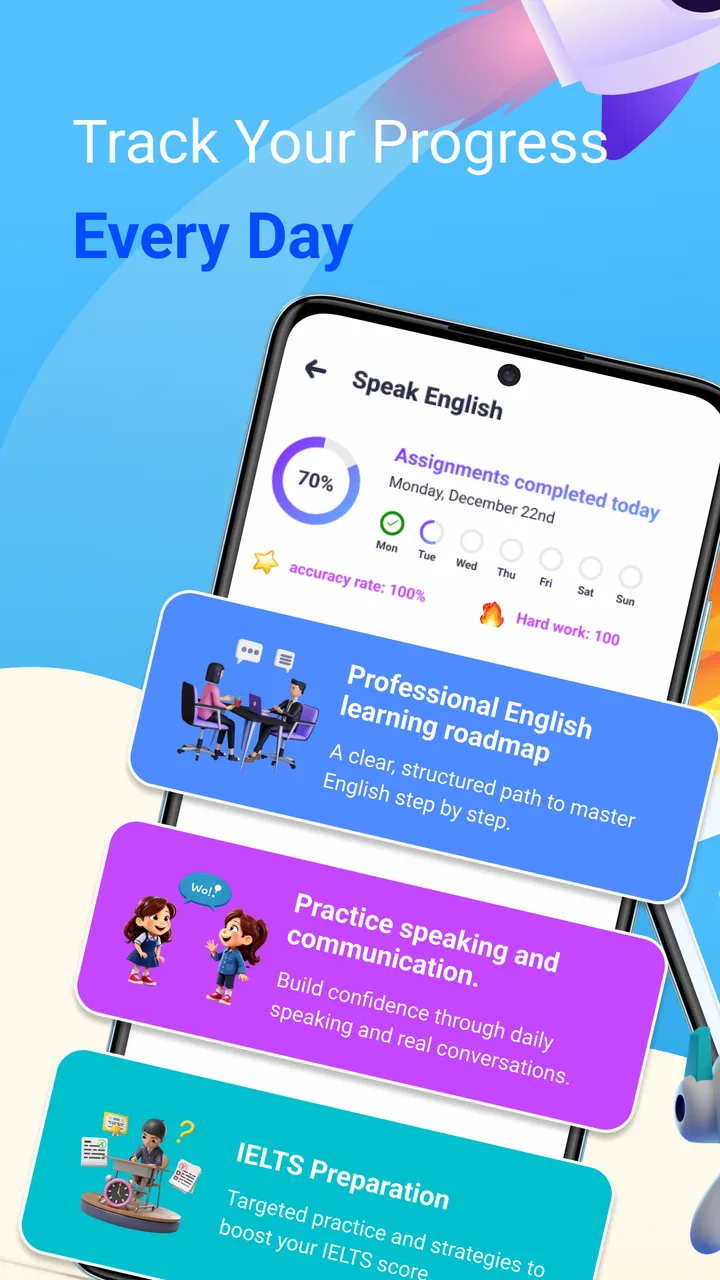
AI English – Learn & Speak offers a comprehensive language learning experience with features such as interactive lessons, real-time pronunciation feedback, vocabulary building, and AI-driven conversation practice. The app also includes daily challenges and personalized learning paths to help users progress at their own pace.
02Is AI English – Learn & Speak suitable for beginners?
Yes, AI English – Learn & Speak is suitable for beginners as well as advanced learners. The app offers tailored lessons that cater to different proficiency levels, ensuring that beginners can start with foundational skills and gradually progress to more advanced topics, while advanced users can refine their language skills.
03How does the app use AI technology in language learning?
The app utilizes AI technology to personalize the learning experience by analyzing user progress and adjusting lessons accordingly. It provides real-time pronunciation feedback, suggests vocabulary enhancements, and simulates conversations, making the learning process more interactive and effective.
04Are there any in-app purchases or subscriptions required?
While AI English – Learn & Speak offers a free version with essential features, there are in-app purchases and subscription options available for users who want access to premium content, such as advanced lessons and additional resources. These purchases enhance the learning experience but are not mandatory.
05Is AI English – Learn & Speak available offline?
AI English – Learn & Speak requires an internet connection for most features to function, including real-time feedback and conversation practice. However, users can download certain lessons for offline access, allowing them to continue learning without an active internet connection.
Pros
- Interactive lessons enhance engagement.
- Wide range of topics for diverse learning.
- Speech recognition improves pronunciation.
- User-friendly interface for all ages.
- Offline mode for learning on the go.
Cons
- Limited free content available.
- Ads can be intrusive at times.
- Requires constant updates for features.
- Some exercises may be too basic.
- Advanced levels need more depth.

AI English – Learn & Speak
Gallery